Monday, July 18, 2016

Hastening Family History and Temple Work

Temples are sacred for the closest communion between the Lord and those receiving the highest and most sacred ordinances of the holy priesthood. It is in the temple that things of the earth are joined with the things of heaven. … The great family of God will be united through the saving ordinances of the gospel. Vicarious work for the dead and ordinances for the living are the purposes of temples.
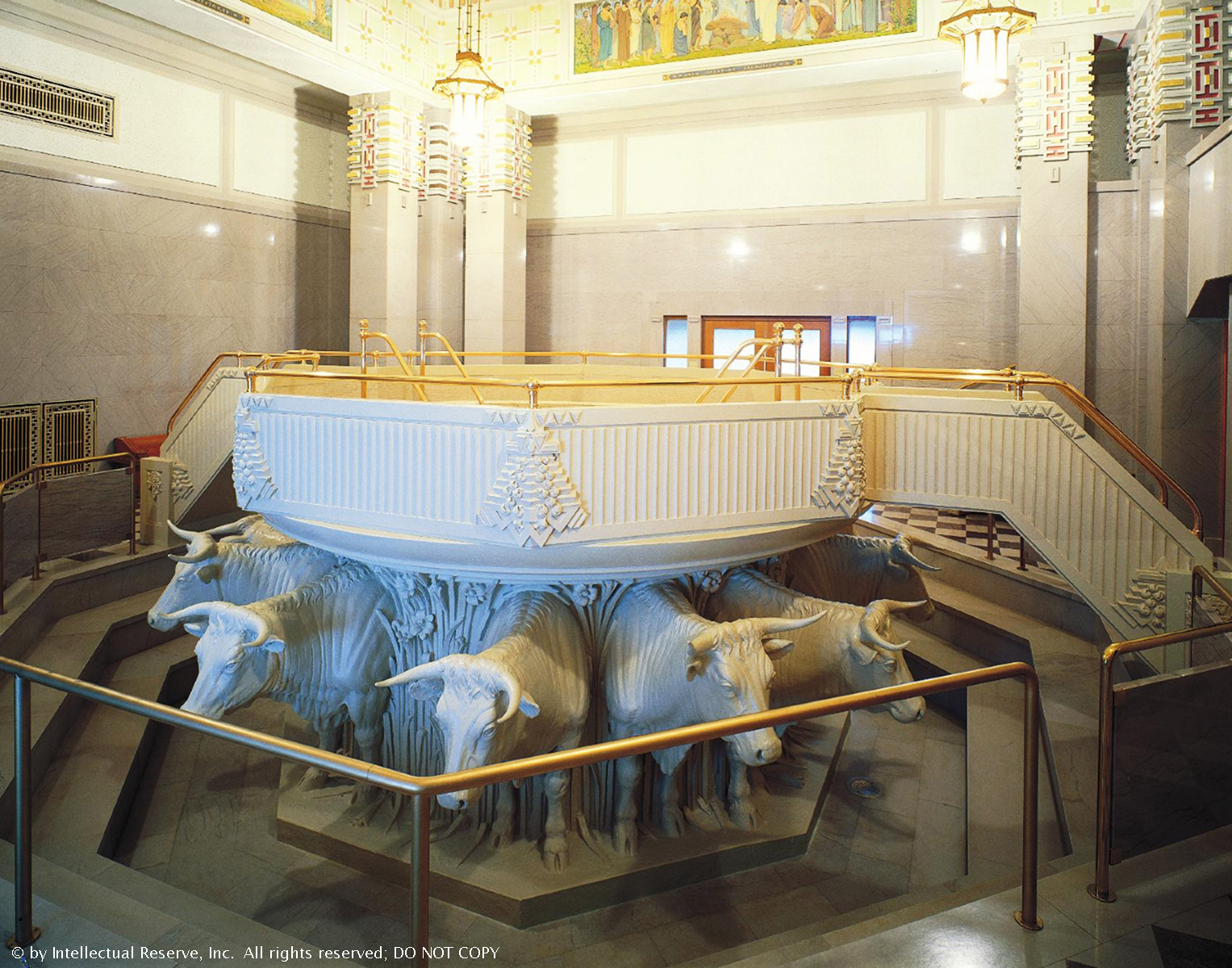
A white baptismal font in the Alberta Canada Temple held on the backs of 12 white oxen.
The gospel proclaimed to the world by the Latter-day Saints is the gospel of Jesus Christ as restored to the earth in this dispensation and is for the redemption of all mankind. The Lord himself has revealed what is essential for the salvation and exaltation of his children. One of these essentials is that temples are to be erected for the performance of ordinances that cannot be performed in any other place.
In response, we often first explain the ordinance known as baptism for the dead. We note that many Christians believe that at the time of death, our status before the Lord is determined for all eternity, for did not Christ say to Nicodemus, “Verily, verily, I say unto thee, Except a man be born of water and of the Spirit, he cannot enter into the kingdom of God” (John 3:5)? Yet we know that many people have died without the ordinance of baptism, and thus, according to Christ’s statement to Nicodemus, they would be eliminated from entering into the kingdom of God. This raises the question, is God just?
The answer is, of course God is just. It is evident that the Savior’s statement to Nicodemus presupposes that baptisms may be done for those who have died who have not been baptized. Latter-day prophets have told us that baptism is an earthly ordinance that can be performed only by the living. How then can those who are dead be baptized if only the living can perform the ordinance? That was the theme of the Apostle Paul’s writing to the Corinthians when he asked this question:
“Else what shall they do which are baptized for the dead, if the dead rise not at all? why are they then baptized for the dead?” (1 Cor. 15:29.)
The endowment is another ordinance performed in our temples. It consists of two parts: first, a series of instructions, and second, promises or covenants that the person receiving the endowment makes—promises to live righteously and comply with the requirements of the gospel of Jesus Christ. The endowment is an ordinance for the great blessing of the Saints—both living and dead. Thus it is also an ordinance performed by the living in behalf of deceased individuals; it is performed for those for whom baptismal work has already been performed.
Another temple ordinance is that of celestial marriage, where wife is sealed to husband and husband sealed to wife for eternity. We know, of course, that civil marriages end at death; but eternal marriages performed in the temple may exist forever. Children born to a husband and wife after an eternal marriage are automatically sealed to their parents for eternity. If children are born before the wife is sealed to her husband, there is a temple sealing ordinance that can seal these children to their parents for eternity, and so it is that children can be sealed vicariously to parents who have passed away. …
Surely we on this side of the veil have a great work to do. … The building of temples has deep significance for ourselves and mankind, and our responsibilities become clear. We must accomplish the priesthood temple ordinance work necessary for our own exaltation; then we must do the necessary work for those who did not have the opportunity to accept the gospel in life. Doing work for others is accomplished in two steps: first, by family history research to ascertain our progenitors; and second, by performing the temple ordinances to give them the same opportunities afforded to the living.
I have learned that those who engage in family history research and then perform the temple ordinance work for those whose names they have found will know the additional joy of receiving both halves of the blessing.
The objective of family history work is to make the blessings of the temple available to all people, both living and dead. As we attend the temple and perform work for the dead, we accomplish a deep sense of alliance with God and a better understanding of his plan for the salvation of the human race. We learn to love our neighbors as ourselves. Truly there is no work equal to that done in the temple.
s we do the work in [the] temple for those who have gone beyond, we are reminded of the inspired counsel of President Joseph F. Smith who declared: “Through our efforts in their behalf, their chains of bondage will fall from them, and the darkness surrounding them will clear away, that light may shine upon them; and they shall hear in the spirit world of the work that has been done for them by their children here, and will rejoice” 
The Prophet Joseph Smith stated, “The greatest responsibility in this world that God has laid upon us is to seek after our dead” [Teachings of Presidents of the Church: Joseph Smith (2007), 475]. He also stated: … “Those Saints who neglect it in behalf of their deceased relatives, do it at the peril of their own salvation” [Teachings of Presidents of the Church: Joseph Smith, 471–72].
e; and let your diligence, and your perseverance, and patience, and your works be redoubled, and you shall in nowise lose your reward, saith the Lord of Hosts” (D&C 127:4).
I encourage you in your efforts with these words of the Prophet Joseph Smith: “Brethren, shall we not go on in so great a cause? Go forward and not backward. Courage, brethren; and on, on to the victory! Let your hearts rejoice, and be exceedingly glad. Let the earth break forth into singing. Let the dead speak forth anthems of eternal praise to the King Immanuel, who hath ordained, before the world was, that which would enable us to redeem them out of their prison; for the prisoners shall go free” (D&C 128:22).
I love this work. I know the Lord will provide all that will be required to accomplish it as we devotedly do our part. May the Lord bless each of us as we make our contribution to this great work, which we must accomplish in our day.

Tuesday, July 12, 2016

The Temple—The Great Symbol of Our Membership


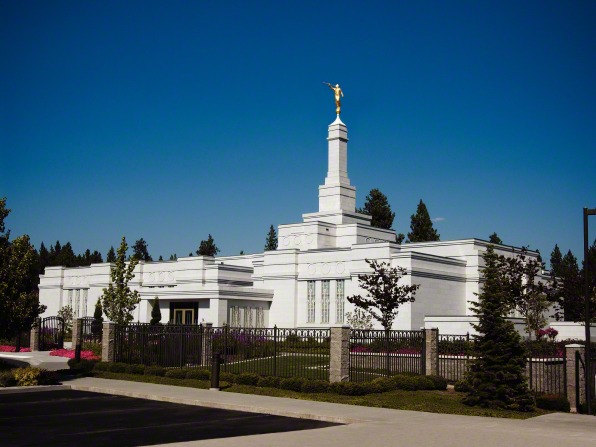
The front of the Spokane Washington Temple, including a view of the entrance, the fence, and trees on the grounds.
Howard W. Hunter’s mother was a faithful member of the Church throughout her life, but his father was not baptized until Howard was 19. Years later, when Howard was a stake president in California, stake members traveled to the Mesa Arizona Temple to do temple work. Before a session began, the temple president asked him to address those who were assembled in the chapel. It was President Hunter’s 46th birthday. He later wrote of that experience:
“While I was speaking to the congregation, … my father and mother came into the chapel dressed in white. I had no idea my father was prepared for his temple blessings, although Mother had been anxious about it for some time. I was so overcome with emotion that I was unable to continue to speak. President Pierce [the temple president] came to my side and explained the reason for the interruption. When my father and mother came to the temple that morning they asked the president not to mention to me that they were there because they wanted it to be a birthday surprise. This was a birthday I have never forgotten because on that day they were endowed and I had the privilege of witnessing their sealing, following which I was sealed to them.”1
Several months later, in January 1995, President Hunter’s last public activity was the dedication of the Bountiful Utah Temple. In the dedicatory prayer, he asked that the blessings of the temple would enrich the lives of all who entered:
“We humbly pray that thou wilt accept this edifice and let thy blessings be upon it. Let thy spirit attend and guide all who officiate herein, that holiness will prevail in every room. May all who enter have clean hands and pure hearts. May they be built up in their faith and depart with a feeling of peace, praising thy holy name. …
“May this House provide a spirit of peace to all who observe its majesty, and especially to those who enter for their own sacred ordinances and to perform the work for their loved ones beyond the veil. Let them feel of thy divine love and mercy. May they be privileged to say, as did the Psalmist of old, ‘We took sweet counsel together, and walked unto the house of God in company.’
“As we dedicate this sacred edifice, we rededicate our very lives to thee and to thy work.”
“The temple is a place of instruction where profound truths pertaining to the Kingdom of God are unfolded. It is a place of peace where minds can be centered upon things of the spirit and the worries of the world can be laid aside. In the temple we make covenants to obey the laws of God, and promises are made to us, conditioned always on our faithfulness, which extend into eternity”
… To have the temple indeed be a symbol unto us, we must desire it to be so. We must live worthy to enter the temple. We must keep the commandments of our Lord. If we can pattern our life after the Master, and take His teaching and example as the supreme pattern for our own, we will not find it difficult to be temple worthy, to be consistent and loyal in every walk of life, for we will be committed to a single, sacred standard of conduct and belief. Whether at home or in the marketplace, whether at school or long after school is behind us, whether we are acting totally alone or in concert with a host of other people, our course will be clear and our standards will be obvious.
Our Heavenly Father has clearly outlined that those who enter the temple must be clean and free from the sins of the world. He said, “And inasmuch as my people build a house unto me in the name of the Lord, and do not suffer any unclean thing to come into it, that it be not defiled, my glory shall rest upon it; … But if it be defiled I will not come into it, and my glory shall not be there; for I will not come into unholy temples” (D&C 97:15, 17).
What a glorious thing it is for us to have the privilege of going to the temple for our own blessings. Then after going to the temple for our own blessings, what a glorious privilege to do the work for those who have gone on before us. This aspect of temple work is an unselfish work. Yet whenever we do temple work for other people, there is a blessing that comes back to us. Thus it should be no surprise to us that the Lord does desire that his people be a temple-motivated people. …
… We should go not only for our kindred dead but also for the personal blessing of temple worship, for the sanctity and safety that are within those hallowed and consecrated walls. As we attend the temple, we learn more richly and deeply the purpose of life and the significance of the atoning sacrifice of the Lord Jesus Christ. Let us make the temple, with temple worship and temple covenants and temple marriage, our ultimate earthly goal and the supreme mortal experience.
“Temple work … gives a wonderful opportunity for keeping alive our spiritual knowledge and strength. … The mighty perspective of eternity is unraveled before us in the holy temples; we see time from its infinite beginning to its endless end; and the drama of eternal life is unfolded before us. Then I see more clearly my place amidst the things of the universe, my place among the purposes of God; I am better able to place myself where I belong, and I am better able to value and to weigh, to separate and to organize the common, ordinary duties of my life so that the little things shall not oppress me or take away my vision of the greater things that God has given us” 
Let us share with our children the spiritual feelings we have in the temple. And let us teach them more earnestly and more comfortably the things we can appropriately say about the purposes of the house of the Lord. Keep a picture of a temple in your home that your children may see it. Teach them about the purposes of the house of the Lord. Have them plan from their earliest years to go there and to remain worthy of that blessing. Let us prepare every missionary to go to the temple worthily and to make that experience an even greater highlight than receiving the mission call. Let us plan for and teach and plead with our children to marry in the house of the Lord. Let us reaffirm more vigorously than we ever have in the past that it does matter where you marry and by what authority you are pronounced man and wife.
Let us be a temple-attending and a temple-loving people. Let us hasten to the temple as frequently as time and means and personal circumstances allow. Let us go not only for our kindred dead, but let us also go for the personal blessing of temple worship, for the sanctity and safety which is provided within those hallowed and consecrated walls. The temple is a place of beauty, it is a place of revelation, it is a place of peace. It is the house of the Lord. It is holy unto the Lord. It should be holy unto us.

Tuesday, June 28, 2016

The Holy Ghost as Your Companion

We can, if we live worthy of it, have the blessing of the Spirit to be with us, not only now and then, as in such remarkable experiences as we’ve had today, but always. You know from the words of the sacrament prayer how that promise is fulfilled: “O God, the Eternal Father, we ask thee in the name of thy Son, Jesus Christ, to bless and sanctify this bread to the souls of all those who partake of it, that they may eat in remembrance of the body of thy Son, and witness unto thee, O God, the Eternal Father, that they are willing to take upon them the name of thy Son, and always remember him and keep his commandments which he has given them.”

To always have the Spirit with us is to have the guidance and direction of the Holy Ghost in our daily lives. We can, for instance, be warned by the Spirit to resist the temptation to do evil.
For that reason alone, it is easy to see why the Lord’s servants have tried to increase our desire to worship God in our sacrament meetings. If we partake of the sacrament in faith, the Holy Ghost will then be able to protect us and those we love from the temptations that come with increasing intensity and frequency.
The companionship of the Holy Ghost makes what is good more attractive and temptation less compelling. That alone should be enough to make us determined to qualify for the Spirit to be with us always.
s you obey, the impressions from the Spirit will come more frequently, becoming closer and closer to constant companionship. Your power to choose the right will increase.
You can know when these impressions to act for Him are from the Spirit rather than from your own desires. When the impressions square with what the Savior and His living prophets and apostles have said, you can choose to obey with confidence. Then the Lord will send His Spirit to attend you.
Those commandments come with this promise from the Lord:
“And now, verily, verily, I say unto thee, put your trust in that Spirit which leadeth to do good—yea, to do justly, to walk humbly, to judge righteously; and this is my Spirit.
“Verily, verily, I say unto you, I will impart unto you of my Spirit, which shall enlighten your mind, which shall fill your soul with joy” (D&C 11:12–13).
I bear you my testimony that God the Father lives, that the resurrected Jesus Christ leads His Church, that President Thomas S. Monson holds all the keys of the priesthood, and that revelation through the Holy Ghost guides and sustains The Church of Jesus Christ of Latter-day Saints and its humble members.
I further testify to you that these wonderful men who have today been speaking to us as witnesses of the Lord Jesus Christ, as members of the Quorum of the Twelve Apostles, are called of God. I know that the Spirit led President Monson to call them. And as you listened to them and their testimonies, the Holy Spirit confirmed to you what I now say to you. They are called of God. I sustain them and love them and know that the Lord loves them and will sustain them in their service. And I do it in the name of the Lord Jesus Christ, amen.

Monday, June 20, 2016

Come Back and Feast at the Table of the Lord


                                           Christ with sheep

“To those who have transgressed or been offended, we say, come back. To those who are hurt and struggling and afraid, we say, let us stand with you and dry your tears. To those who are confused and assailed by error on every side, we say, come to the God of all truth and the Church of continuing revelation. Come back. Stand with us. Carry on. Be believing. All is well, and all will be well. Feast at the table laid before you in The Church ofJesus Christ of Latter-day Saints and strive to follow the Good Shepherd who has provided it. Have hope, exert faith, receive—and give—charity, the pure love of Christ.”1


Throughout his life, President Hunter helped many Church members return to activity. Relating such an experience from early adulthood, he said:
“My ward bishop assigned me as a ward teacher to a brother who boasted he was the oldest deacon in the Church. Home teaching was ward teaching in those days. His problem was that he loved to play golf on Sunday. It was discouraging to meet month after month with him and his wife and see no apparent progress. But finally, the right word was said to him and it struck a responsive chord. The word was covenant. We asked him, ‘What does the covenant of baptism mean to you?’ His expression changed, and for the first time we saw a serious side to him. Eventually he came to our classes, gave up golf, and took his wife to the temple.”3
“We are confident that many have longed to return, but have felt awkward about doing so. We assure you that you will find open arms to receive you and willing hands to assist you.” (Ensign, March 1986, p. 88.)
I think all of us were impressed by this magnanimous appeal akin to what the prophet Alma stated in theBook of Mormon regarding an invitation that was extended by the Lord. He said:
What should we do to help those who have lost their way in the wilderness?
The Lord, our Good Shepherd, expects us to be his undershepherds and recover those who are struggling or are lost. We can’t tell you how to do it, but as you become involved and seek inspiration, success will result from efforts in your areas, … stakes, and wards. Some stakes have responded to previous pleadings and have had remarkable success.
f we do this, eternal blessings will come to us.5
Seeking after the lost, the wayward, and the straying is the Lord’s business. … The prayerful plea of Alma is a good reminder of the sacredness of our task:
“O Lord, wilt thou grant unto us that we may have success in bringing [souls] again unto thee in Christ.
Over the years the Church has made some monumental efforts to recover those who are less active. … And all to what end? It is to save the souls of our brothers and sisters and see that they have the ordinances of exaltation.
We are leading toward one objective for each individual member of the Church. That is for all to receive the ordinances of the gospel and make covenants with our Heavenly Father so they may return to his presence. That is our grand objective. The ordinances and covenants are the means to achieving that divine nature that will return us into his presence again. …
Keep in mind the purpose: to invite all to come unto Christ. …
I testify, my brethren and sisters, to his divinity and power to save those who will come to him with broken hearts and contrite spirits. Through the ordinances and his Holy Spirit, each individual may become clean.10

Sunday, June 5, 2016

“I Was a Stranger”

On the day Relief Society was organized, Emma Smith declared:  "We are going to do something extraordinary....We expect extraordinary occasions and pressing calls."  Those pressing calls and extraordinary occasions presented themselves frequently then--as they do now.
                             Tents in a refugee camp
There are more than 60 million refugees, including forcibly displaced people, worldwide.  Half of those are children. "These individuals have undergone tremendous difficulties and are starting over in....new countries and cultures. While there are [sometimes] organizations that help them with a place to live and basic necessities, what they need is a friend and ally who can help them [adjust] to their new home, a person who can help them learn the language, understand the systems, and feel connected."

As sisters we make up more than half of the Lord's storehouse to help Heavenly Father's children. His storehouse is not composed just of good but also of time, talents, skills, and our divine nature.  Sister Rosemary M. Wixom has taught, "The divine nature within us ignites our desire to reach out to others and prompts us to act."

Recognizing our divine nature, President Russell M. Nelson urged:

"We need women who know how to make important things happen by their faith and who are courageous defenders of morality and families in a sin-sick world...; women who know how to call upon the powers of heaven to protect and strenghthen children and families...

"...Married or single, you sisters possess distinctive capabilities and special intuition you have received as gifts from God.  We brethren cannot duplicate your unique influence."
                                 Aid worker surrounded by children in a refugee camp
A First Presidency letter sent to the Church on October 27, 2015, expressed great concern and compassion for the millions of people who have fled their homes seeking relief from civil conflict and other hardships.  The First Presidency invited individuals, families, and Church units to participate in Christlike service in local refugee relief projects and to contribute to the Church humanitarian fund, where practical.

With these truths in mind, we have organized a relief effort called "I Was a Stranger."  It is our hope that you will prayerfully determine what you can do----according to your own time and circumstance---to serve the refugees living in your neighborhoods and communities. This is an opportunity to serve one on one, in families, and by organizations to offer friendship, mentoring, and other Christlike service and is one of many ways sisters can serve.

The Savior said:

"For I was an hungered, and ye gave me meat:  I was thirsty, and ye gave me drink:  I was a a stranger, and ye took me in:

"Naked, and ye clothed me: I was sick, and ye visited me."

My beloved sisters, we can be assured of Heavenly Father's help as we get down on our knees and ask for divine guidance to bless his children.  Heavenly Father; our Savior, Jesus Christ; and the Holy Ghost are ready to help.
                           Aid worker embracing a refugee
As we consider the "pressing calls" of those who need our help, let's ask ourselves, "What if their story were my story?"  May we then seek inspiration, act on impressions we receive, and reach out in unity to help those in need as we are able and inspired to do so.  Perhaps then it might be said of us, as the Savior said of a loving sister who ministered to Him:  " She hath wrought a good work....She hath done what she could."  I call that extraordinary! 

Tuesday, May 17, 2016

The Scriptures—The Most Profitable of All Study

President Howard W. Hunter had a great love for the scriptures and was a dedicated student of them. This love and study were reflected in his teachings, which were filled with stories and other passages from the standard works. Often when teaching a gospel principle, especially in general conference, he selected at least one story from the scriptures, told it in detail, and drew applications from it.
President Hunter knew the importance of the scriptures in helping a person gain a testimony of Jesus Christ. Accordingly, he often taught from the scriptural accounts of the Savior’s ministry, crucifixion, and resurrection. He declared:
“I am grateful for the library of scripture through which a greater knowledge of Jesus Christ can be learned by devoted study. I am grateful that in addition to the Old and New Testaments, the Lord, through prophets of The Church of Jesus Christ of Latter-day Saints, has added other revealed scripture as additional witnesses for Christ—the Book of Mormon, the Doctrine and Covenants, and the Pearl of Great Price—all of which I know to be the word of God. These bear witness that Jesus is the Christ, the Son of the living God.”
  When we follow the counsel of our leaders to read and study the scriptures, benefits and blessings of many kinds come to us. This is the most profitable of all study in which we could engage. …
Scriptures contain the record of the self-revelation of God, and through them God speaks to man. Where could there be more profitable use of time than reading from the scriptural library the literature that teaches us to know God and understand our relationship to him? Time is always precious to busy people, and we are robbed of its worth when hours are wasted in reading or viewing that which is frivolous and of little value.
n order to be obedient to the law of the gospel and be obedient to the teachings of Jesus Christ, we must first understand the law and ascertain the will of the Lord. This is accomplished best by searching and studying the scriptures and the words of the prophets. In this way we become familiar with what God has revealed to man.
e urge each of you to carefully consider how much time you are currently giving to prayerful pondering of the scriptures.
As one of the Lord’s servants, I challenge you to do the following:
1. Read, ponder, and pray over the scriptures daily as individual members of the Church.
2. Hold family scripture reading on a regular basis. We commend those of you who are already doing this and urge those of you who have not yet started to begin doing so without delay. …
May each of us go forth with a firm resolve to be more prayerful; to seek to live more fully by the Spirit; and to draw closer to our Father in Heaven and his Beloved Son through consistent study of the holy scriptures.
One of the most significant resources the Lord has provided to assist us in accomplishing this divine work is the Book of Mormon, subtitled “Another Testament of Jesus Christ.” [President Ezra Taft Benson] forthrightly admonished us not to neglect reading and abiding by the precepts of this sacred volume of scripture. “Its great mission,” he taught us, “is to bring men to Christ [and thus to the Father], and all other things are secondary.” (Ensign, May 1986, p. 105.) We hope you brothers and sisters are feeding your spirits by regularly reading the Book of Mormon and the other scriptures and using them in your ministries.
The Book of Mormon is the word of God. We invite you to read this wonderful record. It is the most remarkable volume in existence today. Read it carefully and prayerfully, and as you do, God will give you a testimony of its truthfulness as promised by Moroni (see Moroni 10:4).
“Reading, studying, and pondering are not the same. We read words and we may get ideas. We study and we may discover patterns and connections in scripture. But when we ponder, we invite revelation by the Spirit. Pondering, to me, is the thinking and the praying I do after reading and studying in the scriptures carefully” 

Tuesday, May 10, 2016

The Law of Tithing


                         young man writing on donation slip

Shortly before Howard W. Hunter and Claire Jeffs were to be married, Howard went to his bishop to obtain a temple recommend. He was surprised that during the interview, the bishop questioned whether he could support a wife and family on his income. Howard recalled, “When I told him how much I was making, he said the reason for his doubt as to my ability to support a wife was based on the amount of tithing I had paid.”
Until that time, Howard had not been a full-tithe payer because he had not understood the importance of paying a full tithe. He explained, “Because my father had not been a member of the Church during my years at home, tithing had never been discussed in our family and I had never considered its importance.”
Howard said that as he and the bishop continued to talk, the bishop “in his kindly way … taught me the importance of the law and when I told him I would henceforth be a full tithe payer, he continued the interview and relieved my anxiety by filling out and signing a recommendation form.”
The law [of tithing] is simply stated as “one-tenth of all their interest” (D&C 119:4). Interest means profit, compensation, increase. It is the wage of one employed, the profit from the operation of a business, the increase of one who grows or produces, or the income to a person from any other source. The Lord said it is a standing law “forever” as it has been in the past.
Like all of the Lord’s commandments and laws, [the law of tithing] is simple if we have a little faith. The Lord said in effect, “Take out the decimal point and move it over one place.” That is the law of tithing. It’s just that simple.
The tithe is God’s law for his children, yet the payment is entirely voluntary. In this respect it does not differ from the law of the Sabbath or from any other of his laws. We may refuse to obey any or all of them. Our obedience is voluntary, but our refusal to pay does not abrogate or repeal the law.
he Lord has established the law of tithing, and because it is his law, it becomes our obligation to observe it if we love him and have a desire to keep his commandments and receive his blessings. In this way it becomes a debt. The man who doesn’t pay his tithing because he is in debt should ask himself if he is not also in debt to the Lord. The Master said: “But seek ye first the kingdom of God, and his righteousness; and all these things shall be added unto you.” (Matt. 6:33.)
The Lord gave the law [of tithing]. If we follow his law, we prosper, but when we find what we think is a better way, we meet failure. As I travel about the Church and see the results of the payment of tithes, I come to the conclusion that it is not a burden, but a great blessing.
Pay an honest tithing. This eternal law, revealed by the Lord and practiced by the faithful from the ancient prophets down to the present, teaches us to put the Lord first in our lives. We may not be asked to sacrifice our homes or our lives, as was the case with the early Saints. We are challenged today to overcome our selfishness. We pay tithing because we love the Lord, not because we have the means to do so. We can expect that the Lord will open “the windows of heaven” (Malachi 3:10) and shower down blessings upon the faithful.
The payment of tithing strengthens faith, increases spirituality and spiritual capacity, and solidifies testimony. It gives the satisfaction of knowing one is complying with the will of the Lord. It brings the blessings that come from sharing with others through the purposes for which tithing is used. We cannot afford to deny ourselves these blessings. We cannot afford not to pay our tithing. We have a definite relationship to the future as well as to the present. What we give, and how we give, and the way we meet our obligations to the Lord has eternal significance.
A testimony of the law of tithing comes from living it.