Tuesday, May 17, 2016

The Scriptures—The Most Profitable of All Study

President Howard W. Hunter had a great love for the scriptures and was a dedicated student of them. This love and study were reflected in his teachings, which were filled with stories and other passages from the standard works. Often when teaching a gospel principle, especially in general conference, he selected at least one story from the scriptures, told it in detail, and drew applications from it.
President Hunter knew the importance of the scriptures in helping a person gain a testimony of Jesus Christ. Accordingly, he often taught from the scriptural accounts of the Savior’s ministry, crucifixion, and resurrection. He declared:
“I am grateful for the library of scripture through which a greater knowledge of Jesus Christ can be learned by devoted study. I am grateful that in addition to the Old and New Testaments, the Lord, through prophets of The Church of Jesus Christ of Latter-day Saints, has added other revealed scripture as additional witnesses for Christ—the Book of Mormon, the Doctrine and Covenants, and the Pearl of Great Price—all of which I know to be the word of God. These bear witness that Jesus is the Christ, the Son of the living God.”

  When we follow the counsel of our leaders to read and study the scriptures, benefits and blessings of many kinds come to us. This is the most profitable of all study in which we could engage. …
Scriptures contain the record of the self-revelation of God, and through them God speaks to man. Where could there be more profitable use of time than reading from the scriptural library the literature that teaches us to know God and understand our relationship to him? Time is always precious to busy people, and we are robbed of its worth when hours are wasted in reading or viewing that which is frivolous and of little value.
n order to be obedient to the law of the gospel and be obedient to the teachings of Jesus Christ, we must first understand the law and ascertain the will of the Lord. This is accomplished best by searching and studying the scriptures and the words of the prophets. In this way we become familiar with what God has revealed to man.
e urge each of you to carefully consider how much time you are currently giving to prayerful pondering of the scriptures.
As one of the Lord’s servants, I challenge you to do the following:
1. Read, ponder, and pray over the scriptures daily as individual members of the Church.
2. Hold family scripture reading on a regular basis. We commend those of you who are already doing this and urge those of you who have not yet started to begin doing so without delay. …
May each of us go forth with a firm resolve to be more prayerful; to seek to live more fully by the Spirit; and to draw closer to our Father in Heaven and his Beloved Son through consistent study of the holy scriptures.
One of the most significant resources the Lord has provided to assist us in accomplishing this divine work is the Book of Mormon, subtitled “Another Testament of Jesus Christ.” [President Ezra Taft Benson] forthrightly admonished us not to neglect reading and abiding by the precepts of this sacred volume of scripture. “Its great mission,” he taught us, “is to bring men to Christ [and thus to the Father], and all other things are secondary.” (Ensign, May 1986, p. 105.) We hope you brothers and sisters are feeding your spirits by regularly reading the Book of Mormon and the other scriptures and using them in your ministries.
The Book of Mormon is the word of God. We invite you to read this wonderful record. It is the most remarkable volume in existence today. Read it carefully and prayerfully, and as you do, God will give you a testimony of its truthfulness as promised by Moroni (see Moroni 10:4).
“Reading, studying, and pondering are not the same. We read words and we may get ideas. We study and we may discover patterns and connections in scripture. But when we ponder, we invite revelation by the Spirit. Pondering, to me, is the thinking and the praying I do after reading and studying in the scriptures carefully” 

Tuesday, May 10, 2016

The Law of Tithing


                         young man writing on donation slip

Shortly before Howard W. Hunter and Claire Jeffs were to be married, Howard went to his bishop to obtain a temple recommend. He was surprised that during the interview, the bishop questioned whether he could support a wife and family on his income. Howard recalled, “When I told him how much I was making, he said the reason for his doubt as to my ability to support a wife was based on the amount of tithing I had paid.”
Until that time, Howard had not been a full-tithe payer because he had not understood the importance of paying a full tithe. He explained, “Because my father had not been a member of the Church during my years at home, tithing had never been discussed in our family and I had never considered its importance.”
Howard said that as he and the bishop continued to talk, the bishop “in his kindly way … taught me the importance of the law and when I told him I would henceforth be a full tithe payer, he continued the interview and relieved my anxiety by filling out and signing a recommendation form.”
The law [of tithing] is simply stated as “one-tenth of all their interest” (D&C 119:4). Interest means profit, compensation, increase. It is the wage of one employed, the profit from the operation of a business, the increase of one who grows or produces, or the income to a person from any other source. The Lord said it is a standing law “forever” as it has been in the past.
Like all of the Lord’s commandments and laws, [the law of tithing] is simple if we have a little faith. The Lord said in effect, “Take out the decimal point and move it over one place.” That is the law of tithing. It’s just that simple.
The tithe is God’s law for his children, yet the payment is entirely voluntary. In this respect it does not differ from the law of the Sabbath or from any other of his laws. We may refuse to obey any or all of them. Our obedience is voluntary, but our refusal to pay does not abrogate or repeal the law.
he Lord has established the law of tithing, and because it is his law, it becomes our obligation to observe it if we love him and have a desire to keep his commandments and receive his blessings. In this way it becomes a debt. The man who doesn’t pay his tithing because he is in debt should ask himself if he is not also in debt to the Lord. The Master said: “But seek ye first the kingdom of God, and his righteousness; and all these things shall be added unto you.” (Matt. 6:33.)
The Lord gave the law [of tithing]. If we follow his law, we prosper, but when we find what we think is a better way, we meet failure. As I travel about the Church and see the results of the payment of tithes, I come to the conclusion that it is not a burden, but a great blessing.
Pay an honest tithing. This eternal law, revealed by the Lord and practiced by the faithful from the ancient prophets down to the present, teaches us to put the Lord first in our lives. We may not be asked to sacrifice our homes or our lives, as was the case with the early Saints. We are challenged today to overcome our selfishness. We pay tithing because we love the Lord, not because we have the means to do so. We can expect that the Lord will open “the windows of heaven” (Malachi 3:10) and shower down blessings upon the faithful.
The payment of tithing strengthens faith, increases spirituality and spiritual capacity, and solidifies testimony. It gives the satisfaction of knowing one is complying with the will of the Lord. It brings the blessings that come from sharing with others through the purposes for which tithing is used. We cannot afford to deny ourselves these blessings. We cannot afford not to pay our tithing. We have a definite relationship to the future as well as to the present. What we give, and how we give, and the way we meet our obligations to the Lord has eternal significance.
A testimony of the law of tithing comes from living it.

Monday, April 25, 2016

Meeting the Challenges of Today’s World

The choices you make—mission, education, marriage, career, and service in the Church—will shape your eternal destiny.

                                  A side view of the entire Salt Lake Temple, with a view of the grounds around the temple, including a fountain and trees.

Much has been written and said about today’s generation of young adults. Research shows that many resist organized religion. Many are in debt and unemployed. A majority like the idea of marriage, but many are reluctant to take that step. A growing number don’t want children. Without the gospel and inspired guidance, many are wandering in strange paths and losing their way.
Fortunately, young adult members of the Church lag behind in these troubling trends, in part because they are blessed with the gospel plan. That eternal plan includes holding fast to the iron rod—cleaving to God’s word and the word of His prophets. We need to tighten our grip on the rod that leads us back to Him. Now is the “day of choosing” for all of us.
You are living through a critical period of your life. The choices you make—mission, education, marriage, career, and service in the Church—will shape your eternal destiny. This means you will always be looking ahead—looking to the future.
One of the purposes of the scriptures is to show us how righteous people respond to temptation and evil. In short, they avoid it! Joseph ran from Potiphar’s wife.  Lehi took his family and left Jerusalem.4 Mary and Joseph fled into Egypt to escape Herod’s wicked plot.  In every instance, Heavenly Father warned these believers. Similarly, He will help us know whether to fight, flee, or go with the flow of our unfolding circumstances. He will speak to us through prayer, and when we pray, we will have the Holy Ghost, who will guide us. We have the scriptures, the teachings of living prophets, patriarchal blessings, the counsel of inspired parents, priesthood and auxiliary leaders, and, above all, the still, small voice of the Spirit.
The Lord will always keep His promise: “I will lead you along."  The only question is, will we let ourselves be led? Will we hear His voice and the voice of His servants?
testify that if you are there for the Lord, He will be there for you.7 If you love Him and keep His commandments, you will have His Spirit to be with you and guide you. “Put your trust in that Spirit which leadeth to do good. … By this shall you know, all things … pertaining unto things of righteousness.”8
Many of your generation are facing crushing debt. When I was a young adult, my stake president was an investment banker on Wall Street. He taught me, “You are rich if you can live happily within your means.” How can you do it? Pay your tithing and then save! When you earn more, save more. Don’t compete with others to have expensive toys. Don’t buy what you can’t afford.
Education prepares you for better employment opportunities. It puts you in a better position to serve and to bless those around you. It will set you on a path of lifelong learning. It will strengthen you to fight against ignorance and error. As Joseph Smith taught: “Knowledge does away with darkness, suspense and doubt; for these cannot exist where knowledge is. … In knowledge there is power.”  “To be learned is good if they hearken unto the counsels of God.”  Education will prepare you for what is ahead, including marriage.
None of us marry perfection; we marry potential. The right marriage is not only about what I want; it’s also about what she—who’s going to be my companion—wants and needs me to be.
To be ready for marriage, make certain you are worthy to take the sacrament and hold a temple recommend. Go to the temple regularly. Serve in the Church. In addition to serving in Church callings, follow the example of the Savior, who simply “went about doing good.”
Remember, no one can reach upward on your behalf. Only your faith and prayers will cause you to lift yourself and have the mighty change of heart. Only your resolve to be obedient can change your life. Because of the Savior’s atoning sacrifice for you, the power is in you.17 You have your agency, you have strong testimonies if you are obedient, and you can follow the Spirit that guides you.
I bear my testimony that God lives. I bear my special witness that the Savior loves you. “Shall we not go on in [His great] cause? Go forward and not backward.”   As you follow Him, He will strengthen and uphold you. He will bring you up to your highest home. In the name of Jesus Christ, amen.

Sunday, April 17, 2016

Taking the Gospel to All the World

In 1979, Elder Howard W. Hunter, then a member of the Quorum of the Twelve Apostles, said: “I fully believe that in the near future we will see some of the greatest advancements in spreading the gospel to all nations that have ever taken place in this dispensation or any previous dispensation. I am sure that we will be able to look back in retrospect … and record as Luke did, ‘And the word of God increased’ (Acts 6:7).”1

When Elder Hunter spoke those words, political restrictions prohibited missionaries from teaching the gospel in most countries of Eastern Europe and in the Soviet Union. Within 10 years, many of those restrictions began to be lifted. In 1989 and 1990 the Berlin Wall, which had separated West and East Germany for nearly 30 years, was torn down. 

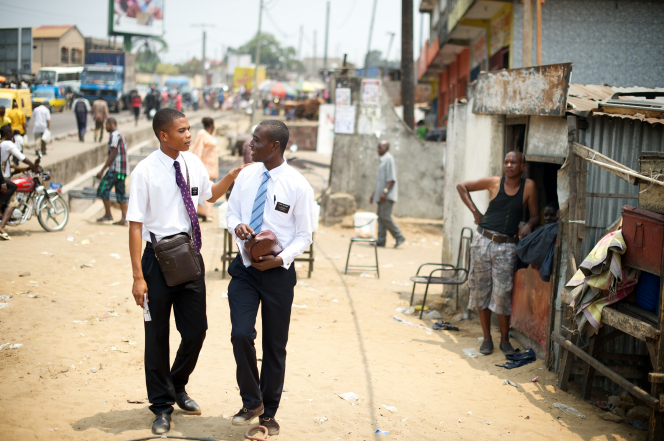
                           An elder missionary turning and putting his hand on his companion’s shoulder while talking and walking down a dirt street in Africa.
President Hunter’s eagerness to reach out to all of God’s children, regardless of nationality or creed, was evident in his work in the Middle East. The First Presidency gave him significant assignments in Jerusalem, including oversight of the construction of the Orson Hyde Memorial Garden and the Brigham Young University Jerusalem Center for Near Eastern Studies. Although proselyting was not allowed in that region, President Hunter built lasting friendships among those with whom he worked, both Jewish and Arabic people. “The purpose of the gospel of Jesus Christ is to bring about love, unity, and brotherhood of the highest order,” he said.4

In the message of the gospel, the entire human race is one family descended from a single God. All men and women have not only a physical lineage leading back to Adam and Eve, their first earthly parents, but also a spiritual heritage leading back to God the Eternal Father. Thus, all persons on earth are literally brothers and sisters in the family of God.

It is in understanding and accepting this universal fatherhood of God that all human beings can best appreciate God’s concern for them and their relationship to each other. This is a message of life and love that strikes squarely against all stifling traditions based on race, language, economic or political standing, educational rank, or cultural background, for we are all of the same spiritual descent. We have a divine pedigree; every person is a spiritual child of God.

The Church, being the kingdom of God on earth, has a mission to all nations. “Go ye therefore, and teach all nations, baptizing them in the name of the Father, and of the Son, and of the Holy Ghost:
“Teaching them to observe all things whatsoever I have commanded you” (Matt. 28:19–20). These words from the lips of the Master know no national boundaries; they are not limited to any race or culture. One nation is not favored above another. The admonition is clear—“teach all nations.” …
As members of the Lord’s church, we need to lift our vision beyond personal prejudices. We need to discover the supreme truth that indeed our Father is no respecter of persons. Sometimes we unduly offend brothers and sisters of other nations by assigning exclusiveness to one nationality of people over another. …
As members of the Church of Jesus Christ, we seek to bring all truth together. We seek to enlarge the circle of love and understanding among all the people of the earth. Thus we strive to establish peace and happiness, not only within Christianity but among all mankind. …
What does the Atonement have to do with missionary work? Any time we experience the blessings of the Atonement in our lives, we cannot help but have a concern for the welfare of [others].
We are to stand as witnesses of God at all times [and] in all places, even until death. We renew that covenant during the sacrament when we covenant to take the name of Christ upon us.
Missionary service is one important way we take upon ourselves his name. The Savior has said if we desire to take upon us his name, with full purpose of heart, we are called to go into all the world and preach his gospel to every creature (see D&C 18:28). …
                                  Two sister missionaries from Romania standing in a store, smiling and talking to a woman in a pink shirt.
As the walls in Eastern Europe … and many other parts of the world come tumbling down, the corresponding need for more missionaries to fulfill the divine commission to take the gospel to all the earth will certainly go up! Are we ready to meet that contingency?
To satisfy the new demands being made upon us in this great missionary work of the last days, perhaps some of us (particularly the older generation whose families are raised) need to take stock to determine whether “walls” that we have built in our own minds need to come down.
We have been privileged to be born in these last days, as opposed to some earlier dispensation, to help take the gospel to all the earth. There is no greater calling in this life. If we are content to hide behind self-made walls, we willingly forgo the blessings that are otherwise ours. The Lord in modern-day revelation explains the great need:
“For behold the field is white already to harvest; and lo, he that thrusteth in his sickle with his might, the same layeth up in store that he perisheth not, but bringeth salvation to his soul.” (D&C 4:4.)
May the Lord bless us that the walls of our minds may not obstruct us from the blessings that can be ours.12

Monday, March 21, 2016

The Atonement and Resurrection of Jesus Christ

“We shall rise from mortal death to have life everlasting, because of the atoning sacrifice and resurrection of the Savior.”


                               garden tomb


During the April general conferences, which are held around the time of Easter, President Hunter often spoke about the Resurrection of Jesus Christ. In the April 1983 general conference he said:
“At this Easter season, I feel strongly the importance of my commission to testify of the reality of the Savior’s resurrection. My brothers and sisters, there is a God in the heavens who loves and cares about you and me. We have a Father in Heaven, who sent his Firstborn of spirit children, his Only Begotten in the flesh, to be an earthly example for us, to take upon himself the sins of the world, and subsequently to be crucified for the sins of the world and be resurrected. …
“It is truly a beautiful message—there will be life after death; we can return to live with our Father in Heaven once again, because of the sacrifice the Savior has made for us, and because of our own repentance and obedience to the commandments.
“In the glorious dawn of Easter morning, when the thoughts of the Christian world are turned to the resurrection of Jesus for a few fleeting moments, let us express appreciation to our Heavenly Father for the great plan of salvation that has been provided for us.”3
The Atonement of Jesus Christ was a foreordained assignment by our Heavenly Father to redeem his children after their fallen state. It was an act of love by our Heavenly Father to permit his Only Begotten to make an atoning sacrifice. And it was a supreme act of love by his beloved Son to carry out the Atonement.
I bear you my testimony, my brethren and sisters, that our Heavenly Father sent his beloved Son, Jesus Christ, into the world to fulfill the conditions upon which the plan of salvation would be operated. The Atonement represents his great love for us.4
“And he will take upon him death, that he may loose the bands of death which bind his people; and he will take upon him their infirmities, that his bowels may be filled with mercy, according to the flesh, that he may know according to the flesh how to succor his people according to their infirmities” (Alma 7:11–12).
Think of it! When his body was taken from the cross and hastily placed in a borrowed tomb, he, the sinless Son of God, had already taken upon him not only the sins and temptations of every human soul who will repent, but all of our sickness and grief and pain of every kind. He suffered these afflictions as we suffer them, according to the flesh. He suffered them all. He did this to perfect his mercy and his ability to lift us above every earthly trial.5
Surely the resurrection is the center of every Christian’s faith; it is the greatest of all of the miracles performed by the Savior of the world. Without it, we are indeed left hopeless. Let me borrow the words of Paul: “If there be no resurrection of the dead, … then is our preaching vain, … and we are found false witnesses of God; because we have testified of God that he raised up Christ. … If Christ be not raised, your faith is vain; ye are yet in your sins” (1 Corinthians 15:13–15, 17).8
Without the Resurrection, the gospel of Jesus Christ becomes a litany of wise sayings and seemingly unexplainable miracles—but sayings and miracles with no ultimate triumph. No, the ultimate triumph is in the ultimate miracle: for the first time in the history of mankind, one who was dead raised himself into living immortality. He was the Son of God, the Son of our immortal Father in Heaven, and his triumph over physical and spiritual death is the good news every Christian tongue should speak.
In the days that followed his resurrection, the Lord appeared unto many. He displayed his five special wounds to them. He walked and talked and ate with them, as if to prove beyond a doubt that a resurrected body is indeed a physical body of tangible flesh and bones. Later he ministered to the Nephites, whom he commanded to “arise and come forth unto me, that ye may thrust your hands into my side, and also that ye may feel the prints of the nails in my hands and in my feet, that ye may know that I am the God of Israel, and the God of the whole earth, and have been slain for the sins of the world.
It is the responsibility and joy of all men and women everywhere to “seek this Jesus of whom the prophets and apostles have [testified]” (Ether 12:41) and to have the spiritual witness of his divinity. It is the right and blessing of all who humbly seek, to hear the voice of the Holy Spirit, bearing witness of the Father and his resurrected Son.10
Easter is the celebration of the free gift of immortality given to all men, restoring life and healing all wounds. Though all will die as part of the eternal plan of growth and development, nevertheless we can all find comfort in the Psalmist’s statement, “Weeping may endure for a night, but joy cometh in the morning.” (Ps. 30:5.)
I have a conviction that God lives and that Jesus is the Christ. As Paul bore testimony to the saints of Corinth by his letter at that Easter season many years ago, I add my witness that we shall rise from mortal death to have life everlasting, because of the atoning sacrifice and resurrection of the Savior. In my mind I picture him with arms outstretched to all who will hear:
“… I am the resurrection, and the life: he that believeth in me, though he were dead, yet shall he live:
“And whosoever liveth and believeth in me shall never die.” (John 11:25–26.)14

Sunday, March 6, 2016

“My Peace I Give unto You”


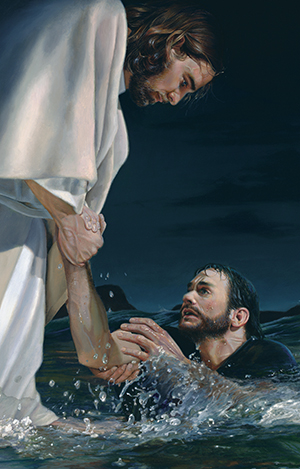
Christ with Peter in water

One of President Howard W. Hunter’s associates in the Quorum of the Twelve described him as a man of “extraordinary patience that comes from great inner peace.”1 President Hunter spoke often about inner peace, teaching that a person can receive it only by turning to God—by trusting Him, exercising faith, and striving to do His will. Such peace helped sustain him through many difficult times.

The peace for which the world longs is a time of suspended hostilities; but men do not realize that peace is a state of existence that comes to man only upon the terms and conditions set by God, and in no other way.

The peace for which the world longs is a time of suspended hostilities; but men do not realize that peace is a state of existence that comes to man only upon the terms and conditions set by God, and in no other way.

In a psalm in the Book of Isaiah are these words: “Thou wilt keep him in perfect peace, whose mind is stayed on thee: because he trusteth in thee.” (Isa. 26:3.) This perfect peace mentioned by Isaiah comes to one only through a belief in God. This is not understood by an unbelieving world.

There is but one guiding hand in the universe, only one truly infallible light, one unfailing beacon to the world. That light is Jesus Christ, the light and life of the world, the light which one Book of Mormon prophet described as “a light that is endless, that can never be darkened.” (Mosiah 16:9.)
As we search for the shore of safety and peace, whether we be individual women and men, families, communities, or nations, Christ is the only beacon on which we can ultimately rely. He is the one who said of his mission, “I am the way, the truth, and the life.” (John 14:6.) …
There is no promise of peace to those who reject God, to those who will not keep his commandments, or to those who violate his laws. The Prophet Isaiah spoke of the decadence and corruption of leaders and then continued in his admonitions by saying: “But the wicked are like the troubled sea, when it cannot rest, whose waters cast up mire and dirt. There is no peace, saith my God, to the wicked.” (Isa. 57:20–21.) …
It seems that two eternal truths must be accepted by all if we are to find peace in this world and eternal life in the world to come. (1) That Jesus is the Christ, the very eternal son of our Heavenly Father, who came to earth for the express purpose of redeeming mankind from sin and the grave, and that he lives to bring us back to the presence of the Father. (2) That Joseph Smith was his prophet, raised up in this latter-day to restore the truth which had been lost to mankind because of transgression. If all men would accept and live these two fundamental truths, peace would be brought to the world.
If you, yourself, resist … temptations and determine to pay the daily price, to live the Law of the Harvest by clean, moral thoughts and practices, by upright, honest dealings, by integrity and conscientiousness in your studies, by fasting, prayer, and worship, you will reap the harvest of freedom and inner peace and prosperity.
A life filled with unselfish service will also be filled with peace that surpasses understanding. … This peace can come only through living the principles of the gospel. These principles constitute the program of the Prince of Peace.
Jesus was not spared grief and pain and anguish and buffeting. No tongue can speak the unutterable burden he carried, nor have we the wisdom to understand the prophet Isaiah’s description of him as “a man of sorrows.” (Isa. 53:3.) His ship was tossed most of his life, and, at least to mortal eyes, it crashed fatally on the rocky coast of Calvary. We are asked not to look on life with mortal eyes; with spiritual vision we know something quite different was happening upon the cross.
“Take my yoke upon you, and learn of me; for I am meek and lowly in heart: and ye shall find rest unto your souls.” (Matt. 11:28–29.)
This peace shelters us from the worldly turmoil. The knowledge that God lives, that we are his children, and that he loves us soothes the troubled heart. The answer to the quest lies in faith in God and in his Son, Jesus Christ. This will bring peace to us now and in the eternity to follow.
At such times when we feel the floods are threatening to drown us and the deep is going to swallow up the tossed vessel of our faith, I pray we may always hear amid the storm and the darkness that sweet utterance of the Savior of the world: “Be of good cheer; it is I; be not afraid.” (Matt. 14:27.)

Sunday, February 7, 2016

Adversity—Part of God’s Plan for Our Eternal Progress

“When [the difficulties of mortality] humble us and refine us and teach us and bless us, they can be powerful instruments in the hands of God to make us better people.”


Christ at pool of Bethesda
I have observed that life—every life—has a full share of ups and downs. Indeed, we see many joys and sorrows in the world, many changed plans and new directions, many blessings that do not always look or feel like blessings, and much that humbles us and improves our patience and our faith. We have all had those experiences from time to time, and I suppose we always will. …

When [the difficulties of mortality] humble us and refine us and teach us and bless us, they can be powerful instruments in the hands of God to make us better people, to make us more grateful, more loving, and more considerate of other people in their own times of difficulty.
Yes, we all have difficult moments, individually and collectively, but even in the most severe of times, anciently or in modern times, those problems and prophecies were never intended to do anything but bless the righteous and help those who are less righteous move toward repentance. God loves us, and the scriptures tell us he “gave his only begotten Son, that whosoever believeth in him should not perish, but have everlasting life” [John 3:16].5
“For it must needs be, that there is an opposition in all things. If not so, … righteousness could not be brought to pass, neither wickedness, neither holiness nor misery, neither good nor bad” (2 Nephi 2:11).
At various times in our lives, probably at repeated times in our lives, we do have to acknowledge that God knows what we do not know and sees what we do not see. “For my thoughts are not your thoughts, neither are your ways my ways, saith the Lord” (Isaiah 55:8).
There have always been some difficulties in mortal life, and there always will be. But knowing what we know, and living as we are supposed to live, there really is no place, no excuse, for pessimism and despair.
In my lifetime I have seen two world wars, plus Korea, plus Vietnam and [more]. I have worked my way through the Depression and managed to go to law school while starting a young family at the same time. I have seen stock markets and world economics go crazy, and I have seen a few despots and tyrants go crazy, all of which caused quite a bit of trouble around the world in the process.
So I hope you won’t believe all the world’s difficulties have been wedged into your decade, or that things have never been worse than they are for you personally, or that they will never get better. I reassure you that things have been worse and they will always get better. They always do—especially when we live and love the gospel of Jesus Christ and give it a chance to flourish in our lives. …
“Come unto me, all ye that labour and are heavy laden, and I will give you rest.
“Take my yoke upon you, and learn of me; for I am meek and lowly in heart: and ye shall find rest unto your souls.
“For my yoke is easy, and my burden is light.” (Matt. 11:28–30.) …
In our own great times of need we must not leave unrecognized this unfailing answer to the cares and worries of our world. Here is the promise of personal peace and protection. Here is the power to remit sin in all periods of time. We, too, must believe that Jesus Christ possesses the power to ease our burdens and lighten our loads. We, too, must come unto him and there receive rest from our labors.
In this last dispensation there will be great tribulation. (See Matt. 24:21.) We know that there will be wars and rumors of wars (see D&C 45:26) and that the whole earth will be in commotion (see D&C 45:26). All dispensations have had their perilous times, but our day will include genuine peril. (See 2 Tim. 3:1.) Evil men will flourish (see 2 Tim. 3:13), but then evil men have very often flourished. Calamities will come and iniquity will abound. (See D&C 45:27.)
“Be strong and of a good courage, fear not, nor be afraid of them: for the Lord thy God, he it is that doth go with thee; he will not fail thee, nor forsake thee. …
“And the Lord, he it is that doth go before thee; he will be with thee, he will not fail thee, neither forsake thee: fear not, neither be dismayed.” (Deut. 31:6, 8.)
And to you, our marvelous generation in modern Israel, the Lord has said:
“Therefore, fear not, little flock; do good; let earth and hell combine against you, for if ye are built upon my rock, they cannot prevail. …
“Look unto me in every thought; doubt not, fear not.” (D&C 6:34, 36.)